AI betting myths are costing punters thousands—from believing AI guarantees profits to thinking high win rates equal success. Time to separate hype from reality and discover what AI betting actually delivers.

Right, let’s get one thing straight from the jump: most people betting with “AI” don’t actually understand what AI is, what it does, or what it can realistically achieve. They’ve fallen victim to AI betting myths that sound convincing but are about as accurate as your mate’s “guaranteed system” that lost him his rent money.
The betting world is absolutely drowning in AI betting myths explained by marketers who’ve never placed a bet in their lives, telegram channels promising 90% win rates (spoiler: they’re lying), and “revolutionary AI systems” that are just Excel spreadsheets with delusions of grandeur.
Here’s what nobody wants to admit: AI is a powerful tool for sports betting when used correctly. But it’s not magic, it’s not foolproof, and it’s definitely not the money-printing machine that social media gurus want you to believe it is.
In this guide, we’re dismantling the most damaging AI betting myths that separate amateur punters from their money. We’ll show you what AI actually does (and doesn’t do), expose the common AI betting mistakes that even smart bettors make, and give you the unvarnished truth about what works in AI-powered sports betting.
No hype. No BS. Just straight talk.
Ready to stop believing fairy tales and start betting smart? Let’s destroy some myths.
Why AI Betting Is Often Misunderstood
“AI” has basically become the betting world’s favorite magic word—right up there with “guaranteed,” “insider tips,” and “can’t lose.” Stick “AI-powered” on literally anything and suddenly it sounds credible, scientific, and worth paying for. This is exactly why AI betting myths spread faster than bad tips in a WhatsApp group.
Here’s why AI attracts so much hype and, unfortunately, so many scams: it sounds impressive to people who don’t understand it. When someone says “our proprietary AI algorithm analyzes 500+ data points,” most punters hear “this is sophisticated and therefore must work” rather than asking the obvious questions like “which 500 data points?” or “how do you actually validate accuracy?”
There’s a bloody massive difference between marketing AI and real AI models. Marketing AI is basically:
- A random number generator with fancy branding
- Basic statistical averages called “machine learning”
- Telegram tipsters claiming their “AI” picked 8/10 winners (while conveniently forgetting the previous 20 losses)
- Services that change their predictions after matches finish (yes, this actually happens)
Real AI models, on the other hand, are transparent about methodology, track verified performance over thousands of bets, explain their reasoning, and—crucially—admit when they’re uncertain or when a bet doesn’t offer value. They focus on long-term edge rather than short-term wins.
Why does misunderstanding AI lead to absolutely terrible betting decisions? Because when you don’t know what AI actually does, you make common AI betting mistakes like:
- Betting your entire bankroll on one “95% confidence” prediction (confidence ≠ probability)
- Chasing losses because “the AI said this was a good bet” (variance exists, mate)
- Ignoring obvious context like injuries or lineup changes because “AI knows better”
- Believing that past wins guarantee future success (the gambler’s fallacy with a tech makeover)
The real problem is that AI betting misconceptions create unrealistic expectations. People think AI is either magic that can’t lose, or complete nonsense that’s all guessing. The truth, as usual, is somewhere in the boring middle: AI is a tool that improves decision-making quality over time when used correctly, but it’s not a shortcut to effortless wealth.
Getting this distinction right is step one to actually profiting from AI betting rather than becoming another cautionary tale about someone who “tried AI betting and lost everything.”
Myth #1 — AI Betting Guarantees Profit
This is the granddaddy of AI betting myths, and it’s responsible for more destroyed bankrolls than a drunk bettor with a credit card at 3am. Let’s be crystal clear: no system wins 100% of the time. Not AI, not professional syndicates, not bookmakers themselves. Anyone claiming their AI guarantees profit is either lying, delusional, or selling something (usually all three).
Here’s what actually happens in reality: even the world’s best AI betting model will lose bets. Regularly. Sometimes in brutal, soul-crushing streaks that make you question mathematics itself. Why? Because sports are inherently unpredictable, variance is a mathematical certainty, and luck exists whether we like it or not.
The critical concept that destroys this myth is understanding variance versus edge. Let me explain with a simple example that’ll save you thousands:
Imagine you have a coin that’s weighted 52% in your favor (this represents having an edge). You flip it 100 times, betting £10 each flip. Math says you should win £40 (52 wins at £10 profit minus 48 losses at £10). That’s your edge—a consistent 2% advantage.

But here’s the brutal reality of variance: there’s roughly a 20% chance you’ll lose money over those 100 flips despite having a genuine edge. You might get 46 heads and 54 tails purely by bad luck. That doesn’t mean your edge vanished—it means variance is a complete bastard who doesn’t care about your feelings or your bankroll.
This is precisely how AI betting accuracy myths get started. Someone uses a solid AI system, hits a rough patch of variance, loses money over two weeks, and declares “AI betting is rubbish!” Nah mate—you just experienced normal statistical variation and didn’t understand what AI actually improves.
What AI actually improves (when done properly):
Expected Value (EV): AI helps identify bets where bookmaker odds are higher than the true probability. If bookies offer 2.20 odds on something that should be 2.00, you’ve found positive EV. Do this consistently over thousands of bets, and you’ll profit—eventually. Not every bet. Not every week. But over time.
Closing Line Value (CLV): This is the gold standard metric that separates real AI from snake oil. If you consistently get better odds than the closing line (the final odds before the match starts), you’re beating the market. Learn more about this crucial concept in our guide to Closing Line Value and AI Betting.
Decision Quality: AI doesn’t guarantee you’ll win tonight’s bet. It guarantees you’re making mathematically sound decisions that will compound into profits over hundreds of bets. Big difference.
Reality check: professional bettors using proper AI systems might target 5-10% ROI annually. Not 50%. Not 100%. Single-digit returns that compound nicely over time but require patience, discipline, and proper bankroll management.
If someone’s selling you “guaranteed profits” with AI, they’re selling you AI betting myths—not actual betting intelligence. Run away. Fast.
Myth #2 — AI Predictions Are Just Guessing
On the complete opposite end of the spectrum, we have the cynics who dismiss AI entirely as “just fancy guessing.” This AI betting myth is usually proclaimed by someone who lost £50 on a single AI prediction and decided the entire field is nonsense. It’s the betting equivalent of trying one gym session, not getting abs immediately, and declaring exercise doesn’t work.
Let’s address the fundamental misunderstanding here: AI models probabilities, not outcomes. This distinction is absolutely crucial and separates people who profit from AI betting from people who rage-delete the app after one losing week.
When a quality AI system says “Team A has a 65% chance of winning,” it’s not predicting they’ll definitely win. It’s saying that in 100 similar situations with similar data, Team A would win approximately 65 times. They’ll still lose 35 times—and some of those losses will come in frustrating clusters that make you question reality.
Here’s the difference between prediction and prediction quality:
Bad prediction: “Manchester United will win 2-1.” (This is a guess about a specific outcome)
Good prediction: “Manchester United has a 58% win probability at current odds of 1.85 (54% implied), offering +4% edge.” (This is a probability assessment with clear value identification)
The first is astrology with spreadsheets. The second is actual mathematical analysis that can be validated over time.
Now, here’s the part that destroys the “AI is just guessing” myth: bookmakers also use AI models. In fact, bookmakers use incredibly sophisticated AI systems built by teams of PhD mathematicians and data scientists. Their entire business model depends on setting accurate probabilities.
When you bet against bookmakers without using similar tools, you’re essentially saying “my gut feeling is better than their multi-million pound AI infrastructure.” How’s that working out for you?
The truth about AI sports betting truth is this: AI isn’t guessing any more than weather forecasting is guessing. Yes, both are probabilistic. Yes, both can be wrong about specific events. But both are dramatically more accurate than random chance, and dismissing them as “just guessing” demonstrates fundamental misunderstanding of how probability works.
Research published in Machine Learning with Applications shows that properly calibrated machine learning models achieved +34.69% ROI versus -35.17% for uncalibrated models when betting on NBA games. That’s not guessing—that’s measurable, verified statistical advantage.
The real question isn’t “is AI just guessing?” It’s “are you using AI that’s been properly validated, or are you falling for one of the many AI betting scams myths that plague the industry?”
Spoiler: most “AI betting” services are indeed just guessing with extra steps. But that doesn’t mean legitimate AI betting doesn’t exist—it just means you need to be smarter about separating wheat from chaff.
Myth #3 — High Win Rate Means Better AI Betting Systems
Right, this is where we separate the gambling addicts from the professional bettors. The obsession with win rate is one of the most destructive AI betting myths in existence, and it’s exactly how scammers hook naive punters into losing their money.
Let me destroy this myth with a simple example that’ll change how you evaluate betting systems forever:
System A: Wins 70% of bets at average odds of 1.30. Sounds amazing, right? Except here’s the math: Win 70 bets × £0.30 profit = £21 profit. Lose 30 bets × £1.00 loss = £30 loss. Total: -£9. You’re losing money with a 70% win rate. Congratulations, you’re mathematically broke but psychologically satisfied.
System B: Wins 45% of bets at average odds of 2.50. Sounds terrible, right? Math time: Win 45 bets × £1.50 profit = £67.50 profit. Lose 55 bets × £1.00 loss = £55 loss. Total: +£12.50. You’re profitable despite losing more bets than you win.
This is why “Our AI has 80% win rate!” is one of the biggest AI betting accuracy myths out there. It’s meaningless without context about odds, stake sizing, and long-term ROI.
Here’s why win rate is catastrophically misleading:
Bookmakers can easily create systems with 90%+ win rates by betting heavy favorites. Bet on every team priced at 1.10 odds or lower, and you’ll win most bets. You’ll also go bankrupt because the 10% of losses wipe out all your 90% of tiny wins, plus the bookmaker’s margin.
This is exactly how AI betting tools mistakes happen—people chase high win rates instead of positive expected value. They feel good winning frequently, even as their bankroll slowly (or quickly) evaporates.
What actually matters more than win rate:
Closing Line Value (CLV): Are you consistently getting better odds than the closing line? This is the single most reliable indicator of long-term profitability. A system with 48% win rate but positive CLV will destroy a system with 65% win rate but negative CLV. Every. Single. Time.
Odds quality: What’s your average odds versus implied probability? If you’re betting 2.00 odds on 55% probability events, you’re printing money. If you’re betting 1.50 odds on 60% probability events, you’re donating to bookmakers.
ROI over large samples: What’s your return on investment over 500+ bets, not 50 bets? Anyone can get lucky over small samples. Sustained profitability over thousands of bets is what separates real edge from variance.
Yield per bet: Are you making 2% per bet or 0.2% per bet? A 52% win rate with 5% average yield crushes a 58% win rate with 1% yield.
The uncomfortable truth that destroys this myth: professional bettors often have win rates between 52-55%. That’s it. They’re not winning 70% or 80% of bets. They’re winning slightly more than half while ensuring the bets they win pay significantly more than the bets they lose.
According to a systematic review published in arXiv analyzing machine learning in sports betting across multiple sports, successful betting systems focus on identifying value and beating closing lines rather than achieving high win percentages. The research found that formal investment strategies with proper risk management significantly enhance profitability—not cherry-picked high win rates.
If someone’s promoting their AI system with “85% win rate!” but won’t show you CLV data, ROI verification, or odds distributions, you’re looking at one of many AI betting scam myths designed to exploit your psychological bias toward winning frequently.
Want to bet with an AI system that focuses on actual profitability rather than vanity win rates? Check out our transparent approach and start betting smarter with 1xBet, which offers the competitive odds essential for AI betting strategies to actually work.
Myth #4 — AI Replaces Betting Knowledge Completely
This particular AI betting myth comes in two equally wrong flavors: people who think AI means they don’t need to know anything about sports, and people who think AI can’t possibly know more than their own expertise. Both groups are spectacularly missing the point.
Let’s address the “AI knows everything” crowd first. No, you can’t just blindly follow AI predictions while knowing absolutely nothing about football, ignoring team news, and betting on markets you don’t understand. That’s not using AI intelligently—that’s outsourcing your brain to a computer and hoping for the best.
Why context still matters even with advanced AI:
Lineups and injuries: AI models are typically trained on historical data with standard lineups. When Liverpool’s entire starting XI is rotated for a Cup match, that’s not “normal” data. AI might not fully account for how dramatically this changes the team’s quality unless explicitly updated with lineup information.
Market inefficiencies: AI can identify value, but you need to understand which markets are most efficient (and therefore hardest to beat) versus which markets are softer. Betting Championship correct scores might offer more edge than Premier League match winners, but you need market knowledge to recognize this.
Contextual situations: Is this a dead rubber match where both teams have nothing to play for? A must-win relegation battle? A derby with massive emotional significance? These factors affect performance in ways that historical data might underweight.
Bookmaker limitations: Knowing which bookmakers limit winning accounts, which offer best odds for specific markets, and how to actually get your bets on requires human judgment and experience.
This is why one of the most common AI betting mistakes is treating AI as an autopilot. AI is a decision support tool, not a replacement for thinking. It’s like GPS navigation—incredibly useful, but you still need to look at the road and use your brain when GPS tells you to drive into a lake.

Where human judgment still plays a crucial role:
- Stake sizing: AI might identify value, but how much should you bet based on your confidence, bankroll, and risk tolerance? That’s your decision.
- Market selection: Which markets align with AI’s strengths? Where is human intuition still valuable? You decide the strategy.
- Discipline enforcement: AI can’t stop you from chasing losses, betting drunk, or doubling stakes after losses. That’s on you.
- Verification and validation: Is this AI system actually working, or are you experiencing lucky variance? You need to track and analyze.
The flip side myth—”AI can’t possibly understand football as I do”—is equally wrong. Here’s the reality: AI can process more data, identify more patterns, and calculate more probabilities than any human possibly could. Your 30 years of watching football give you valuable context and intuition. AI’s analysis of 50,000 matches gives it statistical patterns you’ll never spot.
The optimal approach? Combine them. Use AI to identify mathematical value and probability edges. Use your knowledge to add context, validate the logic, and make final decisions. Together, they’re vastly more powerful than either alone.
This is exactly the philosophy behind proper AI betting systems—augmenting human intelligence rather than replacing it. Understanding this distinction separates people who profit from AI betting from people who either blindly trust it or arrogantly dismiss it.
Both approaches lose money. The middle path wins.
Myth #5 — All AI Betting Tools Are the Same
If there’s one AI betting myth that costs punters the most money, it’s this one: assuming that all services claiming to use “AI” are equivalent in quality, methodology, or effectiveness. This is like assuming all restaurants are the same because they all serve food. Some are Michelin-starred establishments. Some are food poisoning waiting to happen.
The betting industry is absolutely infested with what I’ll politely call “AI-adjacent” services—platforms that slap “AI-powered” on basic statistical averages and charge premium prices for glorified guesswork. Separating legitimate AI betting tools from AI betting scam myths requires understanding what to look for and what red flags to avoid.
Black-box tipsters versus transparent models:
Black-box tipsters operate on the “trust me, bro” principle. They claim to use sophisticated AI but won’t explain their methodology, won’t show you how predictions are generated, and definitely won’t provide verifiable long-term track records. Their typical pitch: “Our proprietary AI algorithm is too complex to explain, but it’s definitely super smart. Subscribe now!”
Translation: they’re either using basic stats they don’t want to admit are basic, or they’re literally making up predictions and hoping variance swings their way.
Transparent models, on the other hand, explain their approach clearly. They might use Poisson distribution for goal predictions, xG data for performance analysis, ELO ratings for team strength—and they’ll tell you exactly how these components combine. Check out our detailed breakdown of AI Betting Models: Poisson, xG, and ELO to see what genuine transparency looks like.
Warning signs of bad AI tools (run immediately if you see these):
- “Guaranteed profits” or “can’t lose” claims (already addressed this myth, but worth repeating—these are lies)
- No verifiable track record or suspiciously perfect past performance (probably cherry-picked or fabricated)
- High-pressure sales tactics like “limited spots available” or “secret AI only 10 people know about”
- Testimonials with no verification (“John from Manchester made £10,000 in two weeks!” Sure he did, mate)
- Focus on wins rather than ROI/CLV (already covered why this is a massive red flag)
- Changing predictions after results (yes, this scam exists—screenshot everything)
- No explanation of methodology (if they can’t or won’t explain how it works, it doesn’t work)
- Promises of insider information (AI doesn’t have insider info—it has data analysis)
What real AI betting systems actually show you:
Methodology transparency: Exactly which models they use, how they’re weighted, what data feeds them, and how they’re validated. No secrets, no mystery sauce—just a clear explanation of the approach.
Verified performance tracking: Long-term results over thousands of bets, including losing periods (because they exist). Not just “we won 8/10 last week” nonsense.
Probability-based predictions: Clear percentage probabilities with confidence intervals, not binary “this will win” predictions.
Value identification: Showing you where bookmaker odds diverge from calculated probabilities, not just picking favorites.
Realistic expectations: Admitting when markets are efficient, when uncertainty is high, and when model confidence is low. Honest about limitations.
Educational content: Teaching you how to evaluate bets yourself rather than creating dependence on their service.
The brutal reality of AI betting tools mistakes is that most people don’t do due diligence before subscribing. They see “AI” and assume it’s legitimate. They see a few winning tips and assume it’s sustainable. They see a slick website and assume it’s professional.
Then they lose money and conclude “all AI betting is a scam” when actually, they just chose a scam that happened to use “AI” in its marketing.
There’s a massive difference between legitimate AI betting platforms and telegram channels run by someone’s cousin who learned Python last week. Treating them as equivalent is one of the costliest AI betting misconceptions you can hold.
Myth #6 — AI Only Works in Big Leagues
Here’s an AI betting myth that’s actually backwards from reality: the belief that AI betting only functions in major leagues like the Premier League, La Liga, or Serie A, while smaller leagues are “too unpredictable” for AI analysis. The truth? Smaller leagues are often where AI betting shines brightest.
Let me explain why this myth is not just wrong, but spectacularly wrong in a way that costs people money.
Why smaller leagues can actually be softer (more profitable):
The efficiency market hypothesis applies to betting just like financial markets. The Premier League has millions of bettors, thousands of professional analysts, and bookmakers dedicating significant resources to getting the odds right. This makes it brutally efficient—finding value is like finding gold nuggets in a thoroughly-picked-over mine.
The Romanian Liga I? The Scottish Championship? League One in England? These leagues have far fewer eyeballs, less analytical scrutiny, and bookmakers paying less attention to getting odds perfect. This creates inefficiencies—gaps between true probability and bookmaker odds that AI can exploit.
One of the biggest common AI betting mistakes is assuming bigger leagues mean better opportunities. Often, it’s the opposite. Professional syndicates actively seek out lower-profile markets specifically because they’re less efficient.

Data quality versus market efficiency trade-off:
Now, there IS a legitimate consideration here: data quality. Premier League matches have shot maps, xG data, tactical analysis, and detailed statistics. Romanian Liga I might have basic stats only. This affects how sophisticated your AI model can be.
But here’s the crucial insight: you don’t need perfect data to beat inefficient markets. A basic AI model in an inefficient market can outperform a sophisticated AI model in a hyper-efficient market. It’s not about having the best tools—it’s about using good-enough tools where the competition is weak.
Think about it this way: would you rather be a decent chess player competing against beginners, or a good chess player competing against grandmasters? The “skill level” might be higher in scenario two, but your win rate will be much better in scenario one.
Where AI can actually shine (and make you money):
- Lower league totals markets: Bookmakers often set these using basic season averages, while AI can incorporate form, tactical matchups, and situational factors
- Asian markets and leagues: Less European/American attention means less market efficiency despite decent data availability
- Niche sports: Handball, volleyball, lower-tier tennis—anywhere bookmakers are spreading their analytical resources thin
- Live betting in smaller leagues: Bookmaker live odds algorithms are often less sophisticated for lower-profile matches
The real truth about AI sports betting truth is that it’s not about which leagues you bet on—it’s about finding markets where your AI model has an informational or analytical edge over the bookmaker’s pricing mechanism.
Sometimes that’s the Premier League. Often, it’s the Championship, League One, or even more obscure competitions where bookmakers are essentially using basic templates rather than bespoke analysis.
This myth persists because people psychologically feel safer betting on leagues they recognize and watch regularly. “I understand the Premier League” feels more comfortable than “I’m betting on Swedish Division 2.” But comfort and profitability aren’t the same thing.
Professional AI bettors go where the value is, not where the prestige is. Understanding this principle separates amateurs from professionals faster than almost anything else.
Myth #7 — AI Betting Is “Set and Forget” (The Laziest AI Betting Myth)
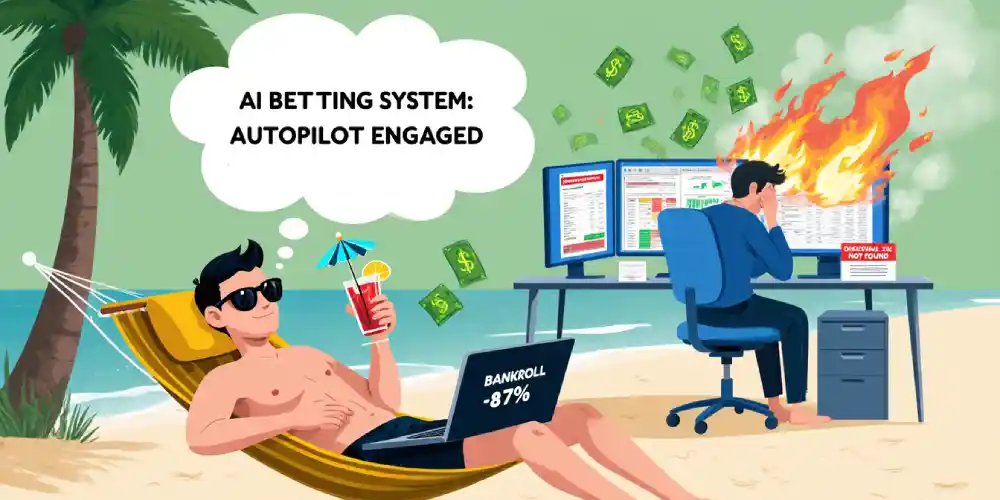
This might be the most seductive and dangerous of all AI betting myths: the fantasy that you can set up an AI betting system, press play, and watch money roll in while you sleep, work, or lie on a beach somewhere. It’s the betting equivalent of “passive income”—a beautiful dream that crashes into reality with the force of a relegation-threatened team’s defending.
Let me absolutely destroy this myth because it’s responsible for more blown bankrolls than any other misconception: AI betting is never “set and forget.” Ever. Period. If someone’s selling you that fantasy, they’re selling you AI betting scams myths, not real betting intelligence.
Why bankroll management still matters (arguably matters MORE):
AI doesn’t manage your bankroll. AI doesn’t stop you from betting 50% of your account on one “high confidence” prediction. AI doesn’t prevent you from increasing stakes after losses to “make it back faster.” These are human decisions, and they’re where most people destroy themselves.
Here’s the brutal reality: you can have the world’s best AI system identifying genuine value bets, and still go completely broke if you:
- Bet too large a percentage per wager (the Kelly Criterion exists for a reason—learn it, use it)
- Chase losses by increasing stakes (the fastest way to turn a bad week into bankruptcy)
- Ignore variance and expect linear growth (some months you’ll lose money despite a positive edge)
- Withdraw profits too early instead of compounding (patience pays, literally)
Professional bettors using AI typically bet 1-3% of their bankroll per wager, sized according to calculated edge. They understand that a 20-bet losing streak is mathematically possible even with a genuine edge. They prepare for variance instead of being destroyed by it.
A study published in Frontiers in Psychology examining sports betting behavior found that “obsession with betting” was the dominant predictor of problematic gambling, not analytical sophistication. The research revealed cognitive dissonance among bettors who recognize bad behavior in others but continue it themselves when emotionally engaged.
Discipline versus overconfidence (the real killer):
Here’s where AI actually makes things MORE dangerous if you don’t understand what you’re doing: it gives you false confidence. You start thinking, “the AI said this is a good bet, so I should definitely do it” without understanding that:
- AI is probabilistic, not deterministic—it’s identifying edge, not guaranteeing wins
- Even positive EV bets lose frequently—that’s how probability works
- Your discipline in following the system matters more than any individual prediction
This is how people ruin genuinely good models with catastrophically bad behavior:
Week 1: Follow AI system, bet sensibly, win some and lose some, up 3% overall. “This is working!”
Week 2: Hit a losing streak (normal variance), panic, double stakes to “recover losses faster.”
Week 3: Bigger losses due to bigger stakes, complete panic, bet 30% of bankroll on one “sure thing” that loses.
Week 4: Bankroll destroyed, blame “AI betting being a scam,” never realize the problem was behavioral, not analytical.
This exact pattern plays out thousands of times. The AI was fine. The predictions were fine. The model had a genuine edge. The person using it destroyed themselves through a lack of discipline.
What “set and forget” actually requires (spoiler: it’s not forgetting):
If you genuinely want semi-automated AI betting that doesn’t require constant attention, here’s what you actually need:
- Automated bankroll management: Fixed percentage staking that adjusts with bankroll size, not emotional decisions
- Strict loss limits: Daily/weekly limits that force you to stop when variance hits hard
- Pre-committed strategy: Written rules about what you’ll bet, how much, and under what conditions—then actually following them
- Regular performance review: Weekly or monthly check-ins to verify system performance, not daily obsessing over results
- Emotional detachment: Treating betting like a business, not entertainment or gambling
Notice how none of this is actually “forgetting” anything? It’s a systematic, disciplined implementation of a proven strategy with emotional control and proper risk management.
The reality is that AI betting requires LESS day-to-day decision-making (because AI handles the analysis) but MORE discipline and adherence to proven systems. You’re not analyzing every match yourself, but you absolutely cannot just “set it and forget it” like some investment portfolio.
According to research from the University of Bath on machine learning for sports betting, successful long-term betting requires selecting models based on calibration rather than accuracy—and implementing them with consistent, disciplined staking strategies that account for variance.
This is why serious AI bettors use platforms like 1xBet that support systematic betting approaches with competitive odds—because automated betting requires the right infrastructure, not just the right predictions. Read our comprehensive 1xBet review to see why it’s ideal for AI betting strategies.
The Real Truth About AI Betting (What Actually Works)
Right, we’ve demolished seven major AI betting myths. Now, let’s talk about what AI betting actually delivers when you understand it properly and use it correctly. This is the unsexy, realistic truth that won’t make you rich overnight but can genuinely improve your betting results over time.
AI improves process, not luck:
The fundamental truth about AI sports betting truth is that AI optimizes your decision-making process, not your short-term results. Think of it like this: going to the gym improves your fitness process, but you’re not getting abs after one session. AI betting improves your bet selection process, but you’re not guaranteed to profit this weekend.
What AI actually does:
- Identifies bets where bookmaker odds are higher than calculated true probability (value betting)
- Processes vastly more data than humans can manually analyze
- Removes emotional bias from bet selection (no more betting on your favorite team because “they’re due”)
- Calculates optimal stake sizing based on edge and confidence
- Tracks performance systematically to validate whether your approach is actually working
What AI doesn’t do:
- Predict exact scorelines or outcomes (it’s not psychic)
- Guarantee any individual bet will win (probability isn’t certainty)
- Eliminate variance or losing streaks (math doesn’t work that way)
- Replace the need for discipline and bankroll management (you’re still human)
Understanding this distinction eliminates most AI betting misconceptions immediately. You’re not buying a money printer. You’re buying better decision-making tools that compound into a long-term edge.
Long-term mindset (the only mindset that works):
Professional AI bettors think in terms of thousands of bets, not dozens. They measure success over seasons, not weekends. They understand that variance means some months will lose money despite doing everything correctly.
This is completely opposite to how most people approach betting. They want immediate validation. They want this weekend’s accumulator to hit. They want to turn £100 into £1,000 by next Tuesday.
That’s not betting with AI. That’s gambling with a tech fetish.
Real AI betting looks more like this:
- Place 20-30 bets per week based on identified value
- Expect roughly 50-55% to win (not 80%)
- Target 2-5% ROI per bet (not 50%)
- Compound winnings over months and years
- Accept that some weeks/months will be losers
- Focus on process quality, not short-term results
Boring? Absolutely. Profitable? Also yes, when done correctly with discipline and patience.
Focus on probabilities, not predictions:
This mindset shift alone will save you thousands in common AI betting mistakes. Stop asking “will this bet win?” Start asking “is this bet offering value relative to true probability?”
A bet at 2.50 odds on a 45% probability event is excellent value (2.50 implies 40% probability, you’re getting 5% edge). You should take it. You’ll still lose it 55% of the time. That doesn’t mean it was a bad bet—it means probability is working exactly as probability should.
Conversely, a bet at 1.50 odds on a 70% probability event is terrible value (1.50 implies 66.7% probability, you’re giving up 3.3% edge to the bookmaker). You should avoid it even though you’ll win it most of the time.
This is the core principle of profitable betting that AI helps you identify consistently: finding spots where your calculated probability differs from bookmaker implied probability, then betting accordingly with proper sizing.
It’s not sexy. It’s not exciting. It’s methodical, systematic, and requires patience. It’s also the only approach that consistently works over time.
How BetwGPT Uses AI the Right Way
Look, we could do the typical sales pitch here about how BetwGPT is “revolutionary” and “guarantees profits” and all that bollocks. But we’ve just spent 3,000+ words destroying those exact myths, so let’s be honest about what we actually do and why it matters.
Model transparency (because black boxes are for scammers):
We explicitly explain our methodology because we’re not hiding anything. Our system combines:
- Poisson distribution for goal-based predictions and totals markets
- Expected Goals (xG) data for performance quality analysis
- ELO ratings for team strength and form evaluation
- Machine learning to weight these models based on league, market type, and historical accuracy
We show you exactly how predictions are generated, what data feeds them, and why specific bets are identified as value. No mystery sauce. No proprietary secrets we can’t reveal. Just a transparent methodology you can understand and evaluate.
This matters because AI betting myths thrive in opacity. When people don’t understand how something works, they either blindly trust it (dangerous) or completely dismiss it (also dangerous). Transparency eliminates both problems.
CLV-focused approach (the metric that actually matters):
We don’t promote our “win rate” because it’s meaningless without context. We focus on Closing Line Value—consistently beating the closing odds indicates genuine edge, regardless of short-term results.
If our AI suggests a bet at 2.20 odds and the closing line is 2.00, we’ve captured +10% CLV. Do this consistently over thousands of bets, and profitability follows mathematically. This is the professional bettor’s metric because it’s the only one that correlates with long-term success.
Learn more about why this matters in our detailed guide: Closing Line Value and AI Betting.
Market timing logic (when to bet matters as much as what to bet):
Our AI doesn’t just identify value—it identifies when to place bets for optimal odds. Sometimes that’s early when odds first release. Sometimes it’s waiting for line movement. Sometimes it’s avoiding markets entirely because they’re too efficient to beat.
This dynamic approach acknowledges that AI betting isn’t one-size-fits-all. Different markets require different strategies, and we’re transparent about which approaches work where.
Responsible betting philosophy (because we don’t want you to go broke):
We actively discourage the behaviors that destroy betting accounts:
- No “guaranteed wins” or unrealistic profit promises
- Clear education about variance and expected losing runs
- Bankroll management guidance and stake sizing recommendations
- Honesty about when markets are efficient, and edges are slim
- Focus on long-term process over short-term results
This might be bad marketing (most people want to hear about easy money, not discipline and patience), but it’s good ethics. We’d rather you bet successfully for years than burn out chasing impossible promises in weeks.
If you’re ready to bet with AI systems that are transparent, realistic, and focused on actual long-term edge, check out our approach and pair it with bookmakers that support serious betting strategies. Join 1xBet here for competitive odds that make AI betting strategies viable.
How to Use AI Betting Without Losing Money (Practical Implementation)
Right, we’ve covered what doesn’t work. Now let’s talk about what actually does work—the practical, unsexy, effective approach to using AI betting without becoming another cautionary tale.
What to track (these metrics matter):
Closing Line Value (CLV): Are you consistently getting better odds than the closing line? This is the gold standard. Track it religiously. If your CLV is consistently positive over 500+ bets, you’re beating the market regardless of short-term profit/loss.
Odds movement: How do odds move after you place bets? If bookmakers consistently move odds in the direction you bet (shortening odds on your selection), you’re identifying value before the market. If they move away, you might be betting on public bias rather than value.
Stake sizing accuracy: Are you following your planned stake sizes, or emotionally varying them? Consistency here is crucial. Track actual stake versus planned stake and identify when emotions override systems.
ROI over rolling windows: Calculate ROI over every 100 bets, every 250 bets, every 500 bets. This shows you whether your edge is sustained or whether early success was variance.
Yield per market type: Which markets are you actually profitable in? Maybe you’re crushing Over/Under but losing on handicaps. Double down on what works, reduce or eliminate what doesn’t.

What to ignore (these things will mess with your head):
Win streaks: Winning 8 bets in a row doesn’t mean you’ve “cracked it” any more than losing 8 in a row means the system’s broken. Both are normal variance. What matters is long-term edge, not short-term clustering.
Hype and testimonials: “John made £5,000 in a week!” Cool story. Probably variance, possibly fabricated, definitely not predictive of your results. Ignore this noise entirely.
Daily profit/loss: Stop checking your account balance every day like a crypto degenerate. Weekly or monthly reviews are sufficient and prevent emotional decision-making based on short-term noise.
Other people’s results: Someone else winning or losing with the same system tells you nothing about whether you’re using it correctly. Focus on your process, your tracking, your discipline.
Gut feelings about “sure things”: Your gut is wrong more often than it’s right. That’s why you’re using AI. Trust the process or don’t use AI—don’t cherry-pick when to follow it based on feelings.
How to start smart (implementation strategy):
- Start small: Begin with tiny stakes (1% of bankroll maximum) for the first 100+ bets. You’re learning the system, testing discipline, and proving edge before scaling up.
- Paper trade first: Track AI predictions without real money for 50-100 bets. Does the edge hold? Are you actually capturing CLV? Validate before risking capital.
- Use one bookmaker initially: Don’t spread across ten different bookmakers at the start. Master one platform, understand its limits and quirks, then expand. We recommend starting with 1xBet for their competitive odds and range of markets.
- Set strict rules: Write down exactly what constitutes a bet (minimum edge required, markets you’ll use, maximum stake percentage). Follow these religiously. No exceptions for “special situations.”
- Track everything: Use a spreadsheet or betting tracker to record every bet, the reasoning, the odds, the outcome, and the CLV. Data doesn’t lie—your memory does.
- Review monthly: At the end of each month, analyze what worked, what didn’t, where you deviated from the plan, and what needs adjusting. Continuous improvement beats stubborn adherence to failing approaches.
- Expect variance: Mentally prepare for 20+ bet losing streaks. They will happen. It’s not the system breaking—it’s probability being probability. Have sufficient bankroll to weather storms.
- Never chase losses: This is the fastest way to destroy your bankroll. Losing a day? Stop betting. Come back tomorrow with a fresh perspective and original stake sizes.
These aren’t sexy tips. They’re boring, disciplined, systematic approaches that separate long-term winners from spectacular failures. Most people skip this unsexy stuff and wonder why they lose money despite “using AI.”
The answer is always the same: AI didn’t fail them. They failed to use AI properly.
Frequently Asked Questions About AI Betting Myths
Can AI really beat bookmakers?
Yes, but not in the way most people think. AI doesn’t “beat” bookmakers by winning every bet—it identifies situations where bookmaker odds are higher than true probability, creating positive expected value. Over thousands of bets, this edge compounds into profitability. The answer to can AI beat bookmakers is: AI helps you beat the closing line consistently, which is the only proven long-term edge in betting. However, it requires discipline, proper bankroll management, and realistic expectations. You’re not getting rich overnight.
Is AI betting legal?
Absolutely yes. Using AI, statistical models, or any analytical tools to inform betting decisions is completely legal everywhere sports betting is legal. You’re simply analyzing publicly available information more effectively. Bookmakers themselves use sophisticated AI systems—using similar tools just levels the playing field. The legality question around AI betting is a non-issue; what matters is using it effectively and avoiding AI betting scams myths that exploit legal AI for illegal practices.
Are AI betting tools scams?
Some are, many aren’t. The betting industry has plenty of services using “AI” in marketing while providing nothing of value—these are scams. However, legitimate AI betting platforms exist that use transparent methodologies, provide verified track records, and focus on long-term edge rather than guaranteed wins. The key is distinguishing between them. Red flags include: guaranteed profit claims, no methodology transparency, perfect historical records, high-pressure sales tactics, and focus on win rate over ROI/CLV. Legitimate AI tools explain how they work, admit limitations, and provide realistic expectations.
What is realistic AI betting accuracy?
This is where most AI betting accuracy myths originate. “Accuracy” in betting isn’t about win rate—it’s about whether your probability assessments are calibrated correctly. A well-calibrated AI system might predict 60% probability events that actually win 60% of the time over large samples. That’s accurate. But you’ll still lose 40% of those bets. Realistic expectations: 52-55% win rate on evens odds, 2-10% ROI annually, positive CLV over 500+ bets. Anyone promising 80%+ win rates or 50%+ monthly returns is either lying or experiencing temporary variance they’re misattributing to skill.
Do professional bettors use AI?
Yes, extensively. Professional betting syndicates and sharp bettors increasingly use AI and machine learning models because they can process more data and identify patterns that humans miss. However, they use AI as one tool among many—combining it with market knowledge, insider information (legal stuff like injury reports, not match-fixing), bankroll management expertise, and disciplined execution. The myth that pros rely purely on gut feeling is outdated. Modern professional betting is heavily analytical, and AI plays a significant role. But AI alone doesn’t make you a professional—discipline, bankroll management, and market understanding do.
How do I avoid common AI betting mistakes?
The most common AI betting mistakes are: (1) Treating AI as a guarantee rather than probability edge; (2) Using poor bankroll management despite having good predictions; (3) Chasing losses when variance hits; (4) Focusing on win rate instead of CLV/ROI; (5) Betting on markets you don’t understand just because “AI said so”; (6) Not tracking performance systematically; (7) Giving up after normal losing runs. Avoid these by understanding what AI actually does (improves decision quality over time), implementing strict bankroll rules (1-3% stakes max), tracking everything, focusing on process over results, and maintaining discipline during inevitable rough patches.
What’s the difference between AI betting predictions and value betting?
AI betting predictions identify what’s likely to happen (probabilities). Value betting is about finding situations where bookmaker odds are higher than true probability—creating positive expected value. The best AI systems do both: they calculate probabilities AND identify where bookmaker pricing creates value. For example, if AI calculates 55% win probability but bookies offer 2.00 odds (50% implied), that’s a value bet. Learn more about this crucial concept: Value Betting Explained.
Can I use AI betting with any bookmaker?
Technically yes, but some bookmakers are better suited for AI betting than others. You need bookmakers with: (1) Competitive odds (AI edge is small, so margins matter); (2) High betting limits or at least tolerance for winning accounts; (3) Wide market coverage; (4) Fast market updates for live betting if using AI for that. Many recreational bookmakers will limit or ban accounts that consistently win using analytical approaches. For AI betting, consider bookmakers like 1xBet that offer competitive odds and support more professional betting approaches. Check our detailed 1xBet review for specifics.
Conclusion: Stop Believing AI Betting Myths, Start Betting Smarter
Right, let’s wrap this up with the brutal honesty that separates people who profit from AI betting from people who lose money while blaming “the system.”
We’ve systematically destroyed seven major AI betting myths that cost punters thousands:
- AI doesn’t guarantee profits—it provides probabilistic edge over thousands of bets
- AI isn’t “just guessing”—it’s mathematical probability assessment
- High win rates mean nothing without odds quality and ROI context
- AI augments betting knowledge, it doesn’t replace thinking entirely
- Not all AI tools are created equal—most are garbage, some are legitimate
- AI often works better in smaller leagues with less market efficiency
- AI betting is never “set and forget”—discipline and management still matter enormously

The real truth about AI betting myths explained is this: most myths exist because people want easy money and marketers are happy to sell that fantasy. The reality is considerably less sexy but actually works: AI improves decision quality, helps identify value consistently, removes emotional bias, and provides mathematical edge that compounds over time with discipline.
It’s not magic. It’s not a shortcut. It’s not going to make you rich next week.
But it IS a legitimate tool that, when understood properly and used correctly with realistic expectations and strict discipline, can genuinely improve your betting results over the long term.
The choice is yours: keep believing AI betting misconceptions and either dismissing AI entirely (missing genuine opportunity) or blindly trusting scam services (losing money faster). Or understand what AI actually does, implement it systematically with proper bankroll management, and join the small percentage of bettors who consistently beat the market.
The difference between these outcomes isn’t intelligence or luck—it’s whether you’re willing to accept boring reality over exciting fantasy.
Ready to use AI betting properly without falling for myths or scams? Explore BetwGPT’s transparent approach to AI predictions, focusing on long-term edge rather than impossible promises. Pair it with bookmakers that support serious betting strategies—join 1xBet here for competitive odds across 50+ leagues that make AI betting strategies actually viable.
And for more on what actually works in AI betting, explore our comprehensive guides:
- AI Betting Models: Poisson, xG, and ELO Explained
- Closing Line Value and AI Betting
- Value Betting Explained
- Best Sportsbooks for AI Bettors
The myths have been destroyed. The truth has been laid out. What you do with this information is entirely up to you.
Will you join the small percentage betting intelligently with AI, or will you keep donating money to bookmakers while believing whatever myth makes you feel better?
Your bankroll. Your choice.